
Untangle the knots, weave new connections.
Trauma-informed therapy for individuals and couples in New York via Telehealth. In person sessions available soon.
About Me


Hi, I'm Olivia Conway, a Licensed Mental Health Counselor in New York City. My approach is rooted in a feeling I had before I ever stepped foot in a Master’s program; good relationships guide us through our darkest hours and give us something to reach for in the brightest ones. I’ve dedicated myself to understanding the intricacies of how humans relate to one another so I can walk with the ones who have experienced humanity at its worst.
That's the work I do now; sitting with people who are carrying complex trauma, childhood abuse and neglect, grief, or the aftermath of relationships that taught them love wasn't safe. Healing isn’t talking your way out of those beliefs. It shows up in the moments you typically wouldn’t think twice about, a pause before you react, a kinder way of talking to yourself, or taking a moment to stop and feel the sun on your face. My work is to help you build toward that steadily, so the question shifts over time from "is it possible?” to "what comes next?”
We learn how to relate to ourselves by experiencing how the world relates to us. I honor the ways identity shapes each of our lived experiences and I center it when it's a focus of your work. All walks of life are welcome.
I draw on psychodynamic psychotherapy, EMDR, Internal Family Systems, and somatic approaches. Each modality has its time and place, but the through-line is the same conviction I started with: who we heal with matters just as much as how.

The Approach
For Individuals
Eye Movement Desensitization & Reprocessing
Using bilateral stimulation (guided eye movements or buzzers held in your hands), to desensitize painful memories. Especially effective for single-incident trauma, PTSD, and clients who feel stuck reliving the past even though they've already talked about it extensively.
Internal Family Systems
Learning the difference between parts of you and what’s actually you. Helping parts release pain so they can protect you when it’s appropriate and relax when it’s not. Great for anxiety, self-criticism, people-pleasing, and resolving internal conflict when you feel like you’re at war with yourself..
Psychodynamic, Relational Psychotherapy
Using the therapeutic relationship & the past to better understand how we show up in the present. For clients who want to explore their lived experiences and better understand their patterns of thought & behavior. Often paired with somatic exercises to improve the body/brain connection.
For Couples & Relationships
Discernment Therapy
Short-term work (usually between one and five 90-minute sessions designed specifically for situations where one or all partners are conflicted. Cultivates clarity; should we keep trying, stay still, or work on changing things?
The Gottman Method
Using research to learn how to fight without causing emotional damage. Building trust that it’s possible to disagree without devolving creates space for vulnerability and connection. Helpful to couples in any stage of the relationship but works best when both are committed to the process.

Care Through Connection

Transparent Fee Structure
Psychotherapy for Individuals
60 Minute Weekly Sessions: $250
Psychotherapy for Relationships
60 Minute Weekly Sessions: $300
Discernment Therapy For Relationships
90 Minute Weekly Sessions: $450
Insurance
Knot & Thread Psychotherapy is a fee-for-service provider, which means we do not bill insurance carriers directly.
If your plan includes out-of-network benefits, we're happy to provide you with a superbill that you can submit to your insurance company for reimbursement.
Sliding Scale Policy
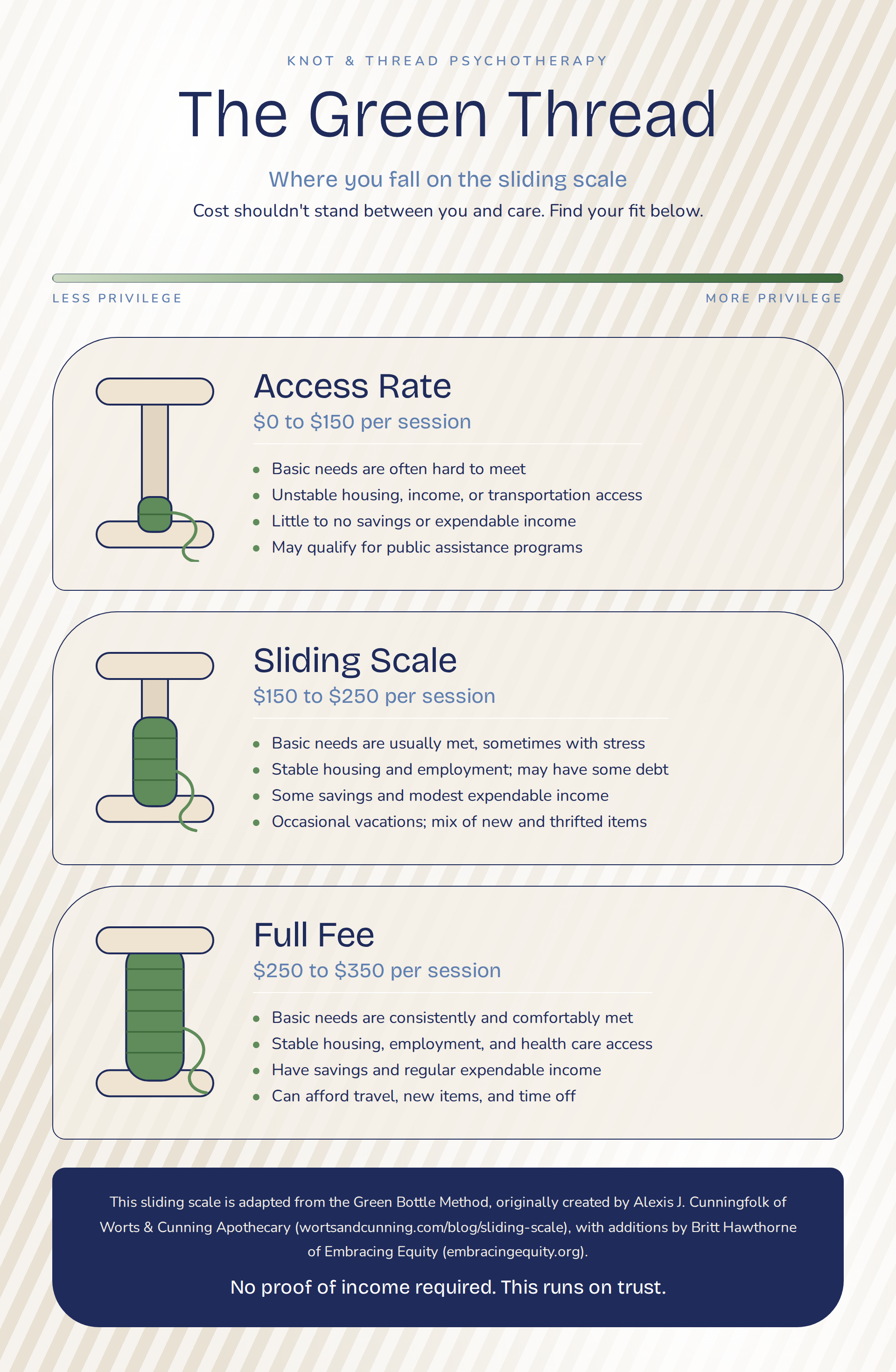
A limited number of sliding scale spots are available for clients who qualify. Not sure if you qualify? Check out The Green Thread chart.
pull the thread, click here to get in touch.
pull the thread, click here to get in touch.
info@knotandthreadpsychotherapy.com
(917) 970-7890

Frequently Asked Questions
-
I'm a private-pay practice, which means I don't bill insurance directly. This lets me spend session time on your care rather than on what an insurer will approve, and it's part of what makes the sliding scale possible. I offer superbills to patients who have insurance plans that offer Out of Network benefits.
-
I use a sliding scale model (the Green Thread, adapted from the Green Bottle Method) to make therapy accessible across a range of financial circumstances. Full fee is $225–$450 per session, sliding scale spots run $150–$225, and a limited number of access-rate spots are available between $0–$150. Visit the Sliding Scale page for full descriptions and choose the tier that fits your situation. Let’s talk it through. No proof of income required, it runs on trust.
-
To me, most approaches have the same goal but speak very different languages. The trick is finding which language speaks to you. You may not know which one is right for you before you start; we'll figure that out together based on what you're working through.
-
Ready for the worst answer in the world?
It depends.
If you come in because you’re in crisis, we’re coping. If you come in to process trauma, we’re starting with safety. If you come in with fears about opening up to a total stranger, we’ll go as slow as we need to. Whatever you bring, I’m curious about; good, bad, or ugly. All that to say, how I show up depends a lot on how you show up, but I tend to be what I like to call ‘clinically conversational.’ This is collaborative work, we’ll develop what our sessions look like together.
-
If you find yourself agonizing over whether or not this is the right relationship, Discernment is for you. This short-term option creates the space to work through whether or not you want to invest in couples therapy.
Couples therapy is more well suited for folks who are committed to improving their relationships, even if it lives outside of the hetero/monogamist norm.
-
Opening up to someone new, especially about the hardest parts of life, takes an enormous amount of effort. It’s important to feel comfortable with the person you’re sitting in the weeds with.
Aside from vibes? Training matters. If you’ve heard of a kind of therapy that appeals to you, make sure the therapist is well trained in that modality.
There’s a lid for every pot, sometimes it just takes a little bit of trial and error to find the one that fits.
-
Yes. The content of our sessions is protected by law and professional ethics, with a few limited exceptions required by law (such as risk of harm to yourself or someone else).
-
MA Clinical Mental Health Counseling, Northwestern University
Basic EMDR Training, EMDRIA Approved
Gottman Level 1 & 2, The Gottman Network
IFS Level 1 Training, The IFS Institute